
Forging a Path: Teacher Representation as an Education Equity Strategy
February 2026
A Path to the Classroom: Who Teaches in South Dakota?
Teachers play a big role in shaping students’ academic success and overall well-being. For children and families, a supportive teacher cultivates young people’s knowledge, skills, curiosity, and confidence, shaping the foundation on which students build their future. Almost everyone can reflect on the teacher that really made a difference in their life. However, despite this value and impact, too many students attend schools that struggle to recruit and retain qualified, supported teachers. The teaching profession faces challenges: barriers to enter the profession, low pay, and limited support. This leaves schools across the state short-staffed and struggling to attract and retain a stable, diverse workforce. When staffing challenges persist, students and academic outcomes suffer.
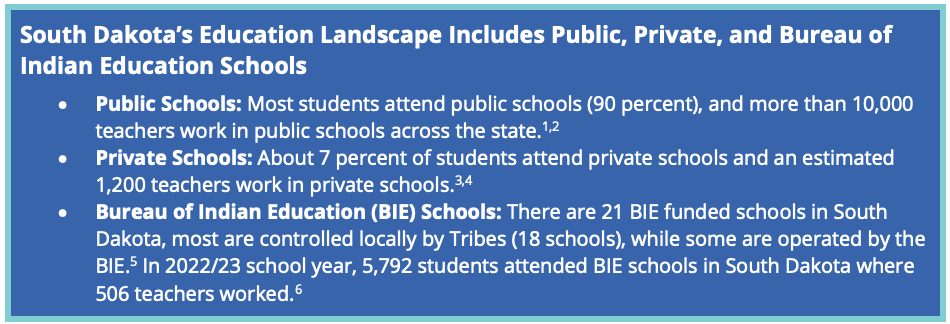
South Dakota’s education landscape is made up of public, private, and Bureau of Indian Education (BIE) schools. All schools face staffing challenges, although the nuances are unique given differences in funding, other requirements, and student makeup. In total, more than 11,000 educators work to teach young people in all corners of the state. Students across all school settings share the same need for stable, well-prepared teachers who understand their communities.
When schools struggle to recruit and retain teachers, students lose the stability and continuity they need to learn and thrive. Research indicates that a teacher’s experience, qualifications, and cultural background matter for student achievement. A teacher with more experience is linked with higher academic achievement for students.7 Students who are taught by teachers of the same race have more positive outcomes for math and reading scores, reduced exclusionary discipline, and improved graduation rates.8 For students with disabilities, a lack of qualified special education teachers means delayed or less effective services.9
Tribal Nations are sovereign governments with inherent authority and responsibility to educate their children. In Tribal communities, policies shaping teacher recruitment and retention affect workforce supply, student achievement, and Tribal self-determination in education. For Tribal Nations, schools are not just places of academic learning, but a place where cultural identity, language, and intergenerational knowledge is shared. As a result, there is a strong priority on hiring educators who come from the community and who have a deep understanding of Tribal culture, language, and history. Incorporating Native culture and language into the curriculum has been shown to strengthen academic outcomes, engagement, and a student’s sense of belonging.10 Given the long history of discrimination and chronic underfunding of education in Tribal communities, and the resulting disparities that persist today, solutions that support the success of Native youth must be a priority. Ensuring stable, culturally grounded educators in Tribal communities is both an equity issue and a governance issue.
A Troubled Journey: The History of Indigenous Education
The federal government failed to honor its treaty and trust responsibilities to provide educational services for Native American students, and the federal government has chronically underfunded many other essential services like health care, housing, economic development, and agricultural assistance in Tribal communities.11 The special trust relationship between the federal government and Tribal Nations obligates support for the general well-being of Tribal communities in exchange for Tribal land. The result has meant underfunded community programs over many decades alongside a loss of land and relocation to areas with less resources.
The history of the education system for Indigenous children is marked by segregation, forced assimilation into the dominant culture, and for many families, children attending boarding schools. Boarding schools stripped Native American children of their culture, language, and connection to their families and communities, enforced assimilation through harsh and often abusive discipline practices, and deliberately sought to replace Indigenous knowledge systems with manual labor training (which has ethical concerns alongside taking the place of other education skills youth needed to gain employment).12 The boarding school era created an ongoing trauma for Indigenous families and a rightful mistrust of the education system. Education should have been a tool for opportunity and growth for Indigenous children and families but instead became a pervasive weapon used against Indigenous people and their culture. This history shapes current challenges, including teacher shortages in Tribal communities.
For Tribal Nations, teacher recruitment and preparation is not only a workforce issue, but also a matter of sovereignty and self-determination. Decisions about who teaches Tribal children, what knowledge is centered, and how schools are staffed are deeply connected to Tribes’ inherent rights to govern their own education systems and sustain their languages, cultures, and communities.
Native American students continue to face added barriers to accessing high-quality education. For example, federal BIE schools have been underfunded for decades, leaving a backlog of repairs and other challenges to meet the needs of an education system for Tribal communities.11 Also, Native American and other BIPOC students are more likely to experience exclusionary discipline in schools in South Dakota, meaning these students miss out on critical instruction time.11 Past and ongoing injustices create persistent disparities in education outcomes for Native American students. Native American students are less likely to read at grade level by the fourth grade, less likely to graduate high school in four years, and more likely to be chronically absent.13 However, these disparities do not have to continue when policies specifically support Indigenous students and the teachers who educate them.
Rough Terrain: Staffing Challenges and Their Impact on Students
Recruiting and retaining a highly qualified and diverse teaching workforce is challenging across the state, with rural and Tribal communities facing heightened challenges. These challenges matter because students are most successful when they learn from experienced educators who reflect their communities.
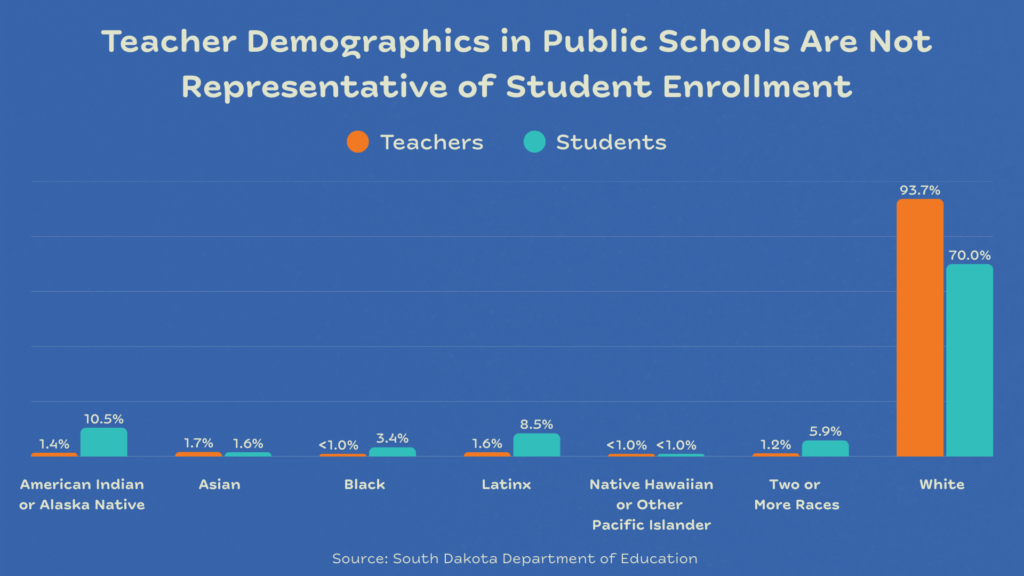
Public schools face challenges hiring a diverse teaching workforce, and current teacher demographics are not representative of student enrollment. Only 1.4 percent of teachers in South Dakota are Native American, yet Native American students make up 10 percent of public school enrollment. Similar disparities exist for Black, Latinx, and multiracial teachers.15 This mismatch limits students’ access to role models who share their lived experiences and reduces opportunities for culturally responsive teaching. Comparable demographic data is limited for private and BIE schools, making it more difficult to fully assess representation across all education settings.
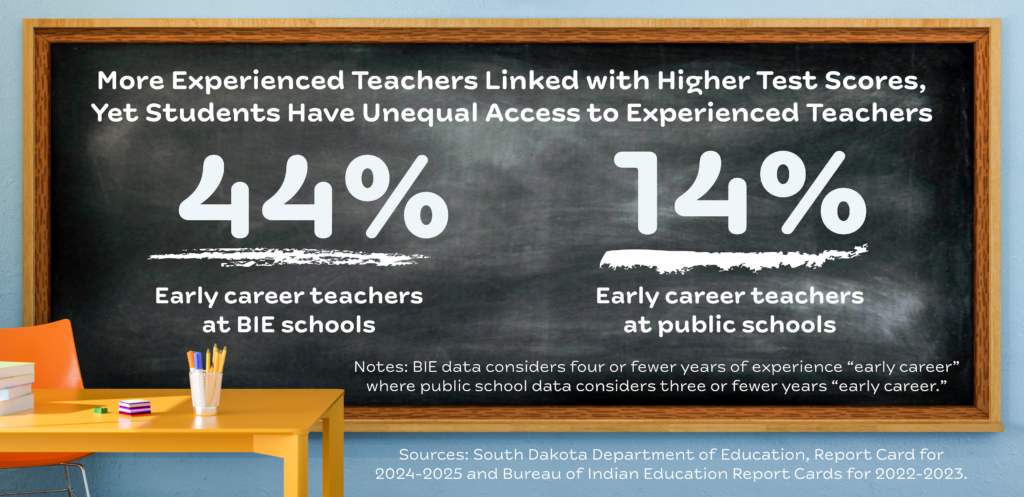
Additionally, students do not have equal access to experienced teachers across the state. At BIE funded schools, 44 percent of educators are early career teachers, meaning they have four or fewer years of experience.6 Compared to public schools, where 14 percent of teachers are early career (in this case three or fewer years of experience).2
Turnover and vacancy of teacher positions across the state provide a look into where shortages are the most pronounced and where students are most affected. In the 2024/25 school year, 1,178 full-time equivalent (FTE) instructional staff turned over, or were no longer employed at the district, representing about 12 percent of the FTE across the state.16 However, about a quarter of these staff moved to another South Dakota district (285 FTE). Other key reasons for leaving their position included employment outside of education (17 percent), retirement (16 percent), and relocation (15 percent). High turnover disrupts students’ learning environments, particularly in elementary and special education settings, where strong relationships and instructional continuity are essential. Self-contained elementary teachers (those in elementary settings providing instruction on multiple subjects to the same group of students) and special education teachers experienced the highest turnover rates, and at the start of the 2025 school year, 137 FTE instructional positions remained vacant, primarily in these same roles.
Public schools located in rural areas and those serving a high proportion of Native American students (25 percent or greater) experience the highest rates of turnover and vacancies relative to their total instructional staff.17 For students in these communities, staffing instability often means larger class sizes, rotating substitute teachers, or delayed access to specialized services, all which can worsen existing educational inequities.
Roadblock to the Classroom: Teacher Certification
One roadblock that South Dakota teachers face to entering the classroom is passing the required standardized licensure tests. After completing both a bachelor’s degree from an approved program and a course in South Dakota Indian studies, candidates must pass the Principles of Learning and Teaching exam as well as any other subject tests related to an endorsement (for example, early childhood, elementary reading, or special education). (Note: there is a traditional licensure route and an alternative certification route, where candidates can teach under a preliminary certificate, but ultimately still must pass the same standardized tests before a full certificate is awarded.) Teachers at both public schools and BIE schools meet these same state-based requirements.
Licensure requirements are in place to ensure instructional quality. However, when these systems are poorly designed or insufficiently supported, they can function as barriers to otherwise qualified candidates. In those cases, it is ultimately students, particularly those in high-need and Tribal communities, who lose out. Each year, an estimated 135 teacher candidates in South Dakota do not pass the licensure exam and are not eligible to earn a license.18 This translates to classrooms without permanent teachers, larger class sizes, or reduced access to specialized instruction, particularly in high-need areas like special education.
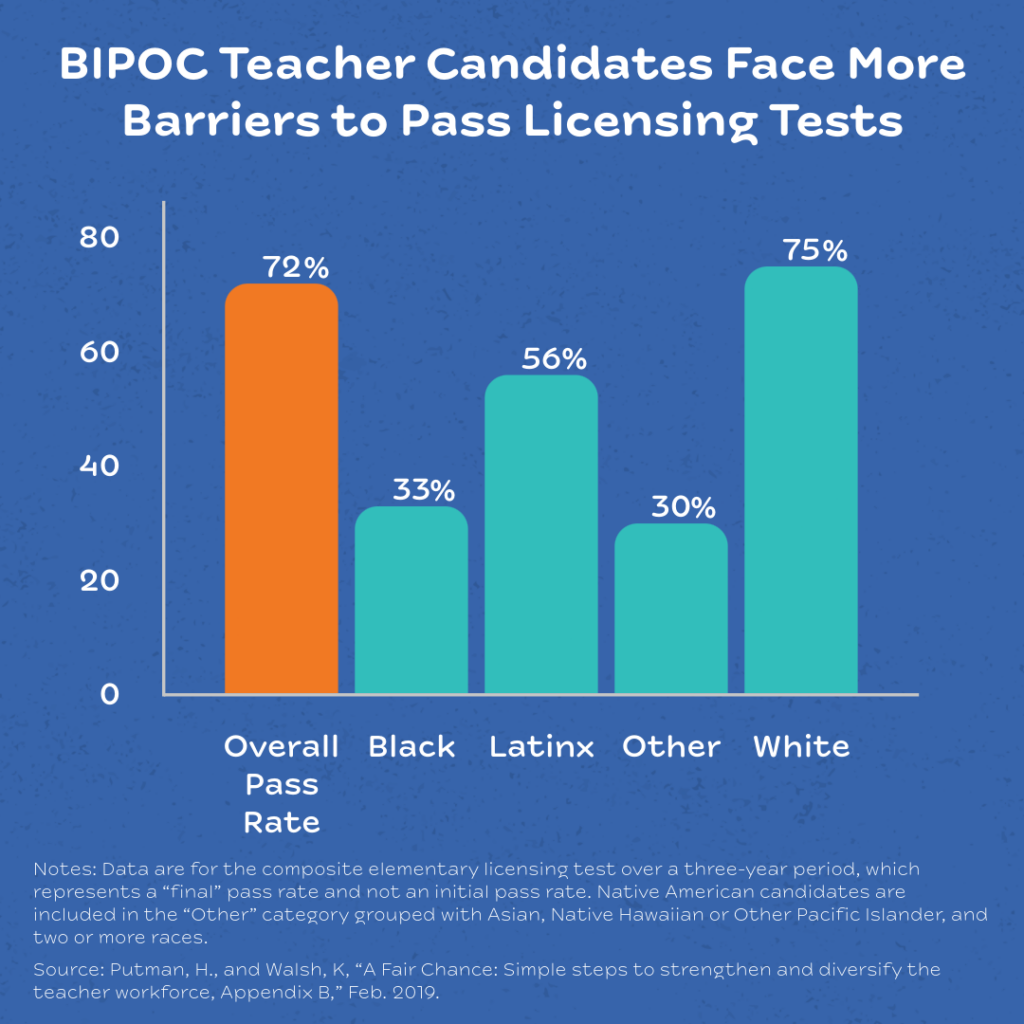
Data from a study in 2019 show that only 46 percent of teacher candidates pass the composite elementary licensing test on the first attempt, bumping up to 72 percent passing after multiple attempts.18 BIPOC teacher candidates face even more challenges to pass licensing tests. In South Dakota, this same study estimates final pass rates of the composite elementary licensing test to be lower for candidates of color, with 75 percent of white candidates passing compared to 33 percent for Black candidates, 56 percent for Latinx candidates, and 30 percent for other races, which includes Native American. More recent data from Title II of the Higher Education Act shows that pass rates vary among teacher preparation programs and institutions but range from 9 percent to 100 percent on elementary subject tests.19 Institutions serving higher proportions of BIPOC candidates tend to report lower pass rates, though small sample sizes limit broader and definitive conclusions.
Current licensure structures can function as a gatekeeping mechanism for Tribal communities when disproportionate pass rates impact Native educators with ties to the community. Tribal Education Directors in South Dakota have shared examples of teacher candidates who begin their education career as paraprofessionals, have demonstrated effectiveness in the classroom, but cannot pass the high-stakes licensure exams. In many examples given, qualified candidates from the community are ultimately displaced by a certified teacher who cannot provide the added benefits of cultural grounding.
Given the low initial pass rates, many candidates must re-take the exam and pay out of pocket for the expense, which currently is $156 for the general Principles of Learning and Teaching exam and ranges from $64 to over $200 for a subject exam.20 This added financial investment may be out of reach for teacher candidates from economically disadvantaged backgrounds.
Other states have pursued alternative approaches to licensure beyond standardized exams. In Maine, Montana, New Mexico and Wisconsin, licensure exams are required only for elementary reading, while candidates in other areas submit a portfolio for review.21 Alabama and Missouri offer flexibility for candidates that just barely fail the licensing exam, with alternatives like a minimum GPA in their coursework or professional development hours.
Requirements for licensing are complex, needing to balance what is best for teacher candidates and schools facing shortages, with what leads to high quality instruction for students. No one right answer seems to stand out in the current research. During the COVID-19 pandemic, some states temporarily waived licensure testing requirements.22 In certain contexts, these waivers increased workforce diversity without immediately affecting teacher performance. In others, student outcomes and teacher effectiveness declined over time for educators certified under waivers.
Ultimately, teacher certification policy involves tradeoffs. States must weigh the need to maintain high standards for instruction against the urgent reality of teacher shortages and the importance of building a workforce that reflects and understands the students it serves. The central question for South Dakota is not whether to lower standards, but how to ensure that licensure requirements accurately measure readiness to teach while minimizing unnecessary barriers that limit students’ access to effective educators.
Difficult Conditions Ahead: Other Barriers to the Classroom
Beyond licensure, other barriers exist for recruiting and retaining teachers, including low salaries and the lack of infrastructure in rural communities to attract qualified teachers. In public schools, the average baseline teacher salary has increased at the state level in the last decade, and in the 2024/25 school year was at $47,179.23 South Dakota falls in the middle of the pack when compared to other states’ baseline teacher salary (ranked 25th in 2025).24 However, in the bigger picture, elementary education teachers fall in the bottom 50 percent of all occupations in South Dakota comparing annual median salary.25
In rural communities, barriers also extend beyond compensation. Accessibility and availability of basic infrastructure can present significant challenges for teachers and their families in rural areas. For example, longer commutes and a shortage of affordable child care make it difficult for educators, particularly early-career teachers and those with young children, to relocate or remain in rural districts.26 For BIE schools, a lack of housing on reservations is a key challenge to recruit teachers, along with a lack of amenities, job opportunities for spouses, and isolated rural settings.11 Ultimately, addressing compensation and infrastructure barriers not only supports teachers, but also ensures that students, regardless of geography, have access to a stable, supported education workforce and the learning environments they need to thrive.
A Roadmap for Change
A diverse and qualified teacher workforce impacts student success. To better support recruiting and retaining teachers in South Dakota, policymakers should:
- Partner with Tribal Nations and Tribal Education Directors to pilot and evaluate alternative teacher certification pathways, including portfolio-based or performance-based assessments, while maintaining clear measures of instructional quality and student outcomes. Existing national research on disparities in high-stakes licensure exams and on performance-based models can inform implementation.
- Invest in teacher salary increases across public and BIE schools.
- Support a deeper understanding of Tribal history and culture for educators in South Dakota and provide resources for educators to incorporate more Tribal history and culture into lessons.
Footnotes
- South Dakota Department of Education, “2025-26 Fall Enrollment Census Count, Public Districts – by District and Grade Level.”
- South Dakota Department of Education, “State Report Card 2024-2025, Educator Qualifications.”
- South Dakota Department of Education, “2025-26 Fall Enrollment Census Count, Non-Public Districts – by District and Grade Level.”
- National Center for Education Statistics, “Table 15. Number of private schools, students, full-time equivalent (FTE) teachers, and 2020–21 high school graduates, by state: United States, school year 2021–22,” Private School Universe Survey.
- Bureau of Indian Affairs, “BIE Schools,” updated Sep. 29, 2025.
- Bureau of Indian Education, “BIE Report Cards,” 2022-2023.
- U.S. Commission on Civil Rights, “Public Education Funding Inequity in an Era of Increasing Concentration of Poverty and Resegregation,” Jan. 2018.
- DeCourcy, K., Wething, H., and Wilson, V., “Improving teacher diversity is key to reducing racial disparities in academic outcomes and addressing the teacher shortage,” Economic Policy Institute, Aug. 2024.
- Gilmour, A., Mason-Williams, L., Bettini, E., “How the Special Education Teacher Shortage Affects Students with LD, and What to Do About It.”
- Executive Office of the President, “2014 Native Youth Report,” Dec. 2014.
- U.S. Commission on Civil Rights, “Broken Promises: Continuing Federal Funding Shortfall for Native Americans,” Dec. 2018.
- Native American Rights Fund, “Trigger Points, Current State of Research on History, Impacts, and Healing Related to the United States’ Indian Industrial/Boarding School Policy,” 2019.
- U.S. Department of Education, Office for Civil Rights, “Civil Rights Data Collection, South Dakota, 2020-21.”
- KIDS COUNT Data Center, “Four-year high school cohort graduation rate by race/ethnicity in South Dakota,” 2024/25. KIDS COUNT Data Center, “Fourth graders who scored below proficient reading level by race and ethnicity in South Dakota,” 2024. South Dakota Department of Education, “State Report Card 2024-2025, School Environment.”
- South Dakota Department of Education, “2023-2024 Staff Information – Instructional Positions.” South Dakota Department of Education, “Student Enrollment Data, 2023 Fall Enrollment, School Level Reports by Ethnicity.”
- South Dakota Department of Education, “South Dakota Public District Instructional Staff,” 2024-25.
- South Dakota Department of Education, combined analysis using data from: “South Dakota Public District Instructional Staff,” 2024-25; “2024-25 Fall Enrollment Census Count, Public - by School, Race/Ethnicity, and Grade Level”; and “2024-25 Rural Schools.” Data was matched by district and grouped by whether student population was greater than or equal to 25 percent American Indian and whether a school was classified as rural or not.
- Putman, H., and Walsh, K., “A Fair Chance: Simple Steps to Strengthen and Diversify the Teacher Workforce,” Feb. 2019. (including “Appendix B: Estimated number of candidates by state and race/ethnicity who cannot earn a license.”)
- United States Department of Education, “2024 Title II Report.”
- Praxis, “Tests required by South Dakota,” accessed on Jan. 29, 2026.
- Swisher, A., “Setting sights lower: States back away from elementary teacher licensure tests,” July 2022.
- Schwartz, S., “What Happened When States Dropped Teacher Licensing Requirements?” Aug. 14, 2025.
- South Dakota Department of Education, “Baseline Teacher Salary.”
- National Education Association, “Educator Pay Data 2025.”
- Bureau of Labor Statistics, “Occupational Employment and Wage Statistics (OEWS) Tables,” May 2024.
- Rider, A., and Harders, K., “Childcare Survey Report Primary Caregiver,” Oct. 2024.